Returning Well
The last thread of this strand is return, and it has been hiding in plain sight, since the Season of Echoes is itself an act of return and every weft piece in these two strands has been the archive coming back to its own ground. Francis Weller names restraint, patience and repetition as soul values, the slow virtues modernity never rewards, and repetition is the one this work has practised most faithfully while talking about it least. The seasons return. The practices return. The reader returns. Nothing in this archive happens once.
Modernity reads return as failure. Its only sanctioned direction is forward, so coming back registers as relapse, regression, going around in circles, being stuck. A culture organised around progress has no honourable category for the second visit, which is why it keeps mistaking spirals for loops. The four seasons, read sideways, turn out to have been training one capacity above almost any other: the capacity to return well.
In Unravelling, grief returned
The first season's grief never moved once and finished. It came in waves, three and four times over, each return carrying material the earlier waves had not reached, sorrow I hadn't processed and didn't know I was carrying. A culture that reads return as failure tells the griever that the second wave means the first one didn't work. The season taught the opposite reading: the return of grief is grief working, each wave going deeper because the earlier ones cleared the way. The mourner's task was never to finish. It was to be findable when the wave came back.
In Drifting, the season returned to itself
The drift built return into its architecture. Three times across twelve weeks the season stopped and came back to the pile, gathering what had accumulated, noticing what had begun to echo, marking the movement even when nothing had visibly gone anywhere. The most reliable signal in the whole season was recurrence: what kept returning without being summoned was what mattered, and the only way to detect recurrence is to keep coming back yourself. The drift could afford to abandon destination precisely because it had replaced it with rhythm.
In Seeding, the offering became rhythm
The third season made the case directly in a week called Slow Reach. Earlier offerings had been single acts, a phrase, a gesture, a seed placed on the table, and the deepening the season asked for was never an increase in size or audience. It was rooting into rhythm: making offerings in ways that deepen relationship, returning to the same ground, the same kin, the same small acts until they thickened into an ecosystem. Roots grow down before branches grow out, and they grow down by returning to the same soil every day. The daily reciprocity ritual carried the same teaching at the smallest scale, one offering, repeated, until repetition itself became the gift.
In Resonance, return became the whole art
The fourth season finally said it outright. Instruments drift, strings stretch, the wood contracts, and so tuning has to happen again and again, every rehearsal, every performance. The point was never to hold a static perfection, and the season's most quotable line refused failure its usual definition: we don't fail when we fall out of resonance, we only fail if we forget how to return. Repair, pause, retune, come back. The entire musical architecture of the season rested on a practice that modernity would classify as going backwards.
The spiral, distinguished from the loop
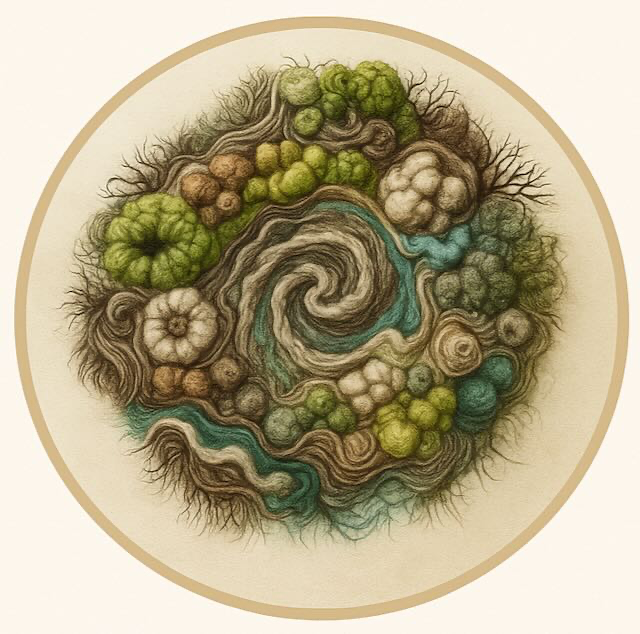
Here is the connection that closes this strand. The four seasons never asked anyone to arrive. They asked for four kinds of return: be findable when the grief comes back, keep coming back to the pile, root the offering into rhythm, and retune as many times as the instrument drifts. The difference between a loop and a spiral cannot be seen from inside a single pass, since both involve coming back to the same place. The difference is depth, and depth only reveals itself to the one who returns. Every weft thread in these two strands found the same shape: the body answering at four depths, the same route walked four ways, the dead approaching by degrees. The spiral was never a path through the seasons. It was what the seasons looked like to someone returning well.
So the second strand closes where the Season of Echoes began, with the recognition that going back over old ground is not the opposite of the work. It is the work, the tending of place when the place is you. The practice inside this final echo is simply the next return you were already going to make, to the walk, to the grief, to the practice you let lapse, to a season of this archive you read once and hurried past. Make the return deliberately this time, and notice the one thing the first visit could not have shown you, since it only becomes visible from one layer further down. Whatever it is, the spiral put it there for the second visit, which is a quiet way of saying it was put there for you.
If this echo prompted a return you had been postponing, or revealed something only the second visit could show, I'd love to hear about it. The comments are open below, and unfinished fragments are as welcome as polished accounts.
Walk alongside this work
New posts arrive gently, in season. Subscribe on Substack to receive them, or visit The Seed Bank for printable practices.
Subscribe Visit The Seed Bank