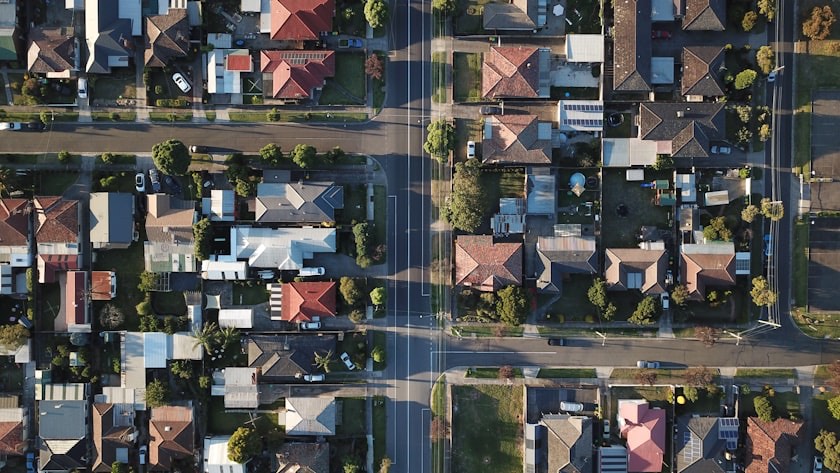
A new strand of weft begins here, at my front door. For the entire life of this work I have walked the same route: a tree-lined suburban street, a stretch of running water, the ordinary circuit of an ordinary place. The route has not changed in four seasons of writing but the walking has varied enormously.
Walking appears in every season of this work and I think I now understand why. Each season developed its lesson indoors, in writing and reading and grief and listening, and then sent that lesson out the same front door to be learned by the legs. Reading back, I can count four distinct walks that happened to share one body and one route.
The walk that mourns
In the Season of Unravelling, walking was how grief moved when it could not be thought through. Some of the grief work could only be done alone, walking, allowing the old stories to loosen their grip in silence, walking until the weight in the chest lightened. The kinship noticing walk belonged to this season too: arriving without agenda, letting the land notice you back, offering a silent I see you to whoever turned out to be present. The mourning walk asks nothing of the walker except continuing, which is the only demand a grieving person can reliably meet. The legs keep faith while everything else is composting.
The walk that wanders
In the Season of Drifting, the walk lost its circuit. Edge-walking sought out threshold places, the tidal zone, the riverbank, the urban in-between, anywhere two worlds meet and neither wins. The season’s most tender story was a walk: two people in fog with no route and no destination, falling into rhythm, pointing out lichen and the sound of a distant eagle, agreeing without words to keep going in a direction neither could name. The wandering walk has no obligation to arrive. Its whole work is perception, and it strengthens the walker’s tolerance for not knowing where the path leads, one unhurried step at a time.
The walk that tends
In the Season of Seeding, walking became rounds. Tending the soil meant literally walking the field, moving through territory after territory of the inner ground to notice what was compacted, what was contaminated, what was living loam. The reciprocity rituals of that season fitted naturally inside a walk: one small offering each day to the ecosystem that holds you, litter lifted, a plant watered, attention paid. The tending walk is the gardener’s walk, the farmer’s slow circuit of the fences. It carries a quiet responsibility the wandering walk never had, and it can carry that responsibility precisely because the wandering walk widened the perception first.
The walk that tunes
In the Season of Resonance, the walk turned inward to the soles of the feet. The grounding walk gave the instruction in full: step slowly, heel down first and then toe, and with each step say here, now, letting the ground retune you. After a season of tone and tuning and harmony, the walk became the most portable tuning fork available, a way of returning to coherence that requires no instrument beyond the body and no concert hall beyond the footpath. The tuning walk can be done in forty steps between the car and the office door. It restores pitch rather than covering distance.
One route, four walks
Modernity offers two general understandings of walking: transportation and exercise, distance covered or steps counted, and both of them treat the walk as a means. The four seasons quietly recovered four other walks, the walk that mourns, the walk that wanders, the walk that tends, and the walk that tunes, and every one of them treats the walk as the thing itself.
The deeper recognition sits in the unchanged route. Nothing about my street announced which season it was holding. The same trees, the same water, the same footpath cracks carried the mourning and the wandering and the tending and the tuning without ever needing to be a wilderness, a retreat, or a pilgrimage trail.
A practice that needs a special landscape has admitted that ordinary ground cannot hold it. The walk argued the opposite for four straight seasons, which makes it perhaps the most compelling evidence in the whole archive that the sacred really can take root in a suburb.
The practice inside this echo is tomorrow’s walk, whichever one it already is: the school run, the bins, the shops, the platform at the end of the street. Before your mind decides what the walk is for, let your feet report which of the four walks they are actually doing. Some mornings the legs are mourning something the mind has not caught up with. Some mornings they are wandering inside a perfectly fixed route, or making rounds, or quietly retuning you between the front door and the gate.
The route will not tell you but the walking will.
Find this in book form
The Season of Unravelling has its own home beyond Substack now. It’s the first in a four-part Almanac, the expanded long-form telling of this whole year-long inquiry, with Unravelling, Drifting, Seeding, and Resonance each becoming their own book.
This first one, The Season of Unravelling, is 59 pages: longer than a single Substack post, shorter than a commitment. It weaves the original posts into one fuller arc, with the threads, the practices, and the reflections that the weekly format never had room for. It’s currently free to read on Kindle Unlimited, or available to purchase on Amazon.
The Season of Drift, Seeding, and Resonance are still being woven into their own long-form editions, so if this one resonates, there’s more of the Almanac still to come.