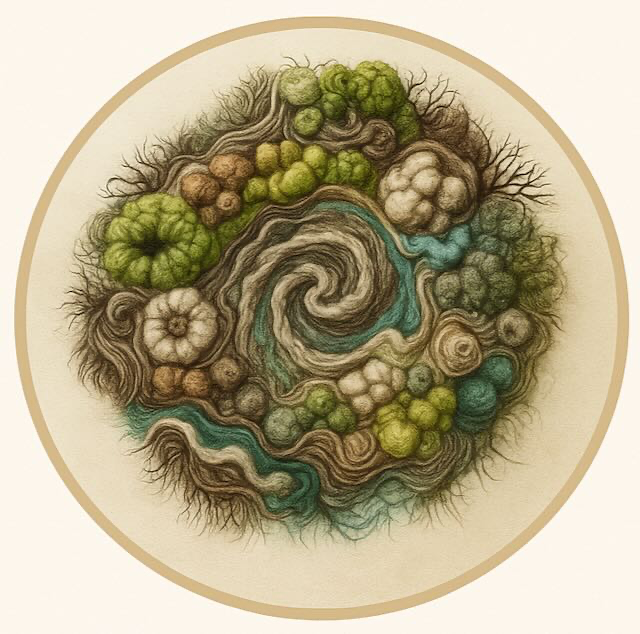
The Midden
The ninth thread concerns what gathers. Along this continent's waterways sit shell middens, accumulations of shell and ash and bone built up over thousands of years of meals and gatherings, and archaeologists trust them above almost any other record for one reason: middens record what actually happened, day after day, while monuments record what people wanted remembered. A midden is the honest archive of a life lived in place, written in leavings rather than declarations.
Reading back across the four seasons, I find a midden in every one of them. Each season kept a container for what fell, gathered, lingered or got carried, and each season developed its own way of reading that container. The archive never named the habit, so the ninth thread is the habit itself: this work has never really produced anything. It has accumulated, and then read the accumulation.
In Unravelling, the heap
The first season's container was the compost heap, and what went into it was the old self. Each word a thread from the old self, I wrote then, laid down to feed whatever comes next. Grief, identities, the stories that no longer held: nothing was discarded and nothing was kept, since the heap occupies the precise position between those two fates. A compost heap is read in only one way, by what eventually grows from it, which means the reading takes seasons and cannot be hurried. The heap taught the work its first lesson about leavings: they are not waste, they are the future's raw material at an early stage of its becoming.
In Drifting, the pile
The second season formalised the gathering into a ritual that returned three times: the drift pile. Shells, half-thoughts, incomplete threads, the beauty of what doesn't need to be finished to be real, all of it gathered without sorting and revisited without agenda. I called the pile compost-adjacent intelligence at the time, and its reading practice differed from the heap's. A drift pile is read by noticing what calls to each other, which fragments have begun to echo, what kept returning without being summoned. The pile taught patience of a different kind: meaning arrives between the fragments, in its own time, and only for the reader who comes back.
In Seeding, the sack
The third season's container travelled. The seed sack held everything carried long before its purpose was known, phrases, dreams, curiosities, aches that wouldn't leave, and the season's pivotal act was simply opening it. The rummage became the reading practice: laying out what had been carried, holding each seed against adjacent shapes to discover what it wasn't, asking better questions of the almost-fits. A sack differs from a heap and a pile in one important way, since its contents are still alive and waiting rather than breaking down, and the rummage is how a carrier discovers which of their leavings were never leavings at all.
In Resonance, the lingering
The fourth season's container had no walls. Conversational residue, I called it: the question of what an exchange leaves in the field once the words have ended, whether you walk away more alive or more depleted, what resonance lingers like the hum of a bell after it's struck. The reading practice here is the subtlest of the four, a pause at the end of contact to notice what remains in the body. The lingering is a midden laid down in the nervous system, one conversation at a time, and most of us have been depositing into it for decades without once stopping to read it.
Reading the leavings
Here is the connection I never made while the seasons were being written. Modernity has waste: material that leaves, gets taken away, and owes nobody a return. The seasons have no waste anywhere in them. Everything that falls in this work lands in a container, the heap, the pile, the sack, the lingering, and every container comes with a way of being read: by what grows, by what calls to each other, by rummage, by what remains in the body. The work's real method was never production. Production is the monument habit, the declaration of what should be remembered. The work's method has been the midden habit, the slow accumulation of the actual, trusted precisely because nobody curated it.
The practice inside this echo is to find one of your own middens and read it instead of clearing it. Every ordinary life keeps several: the notes app full of half-thoughts, the drawer of things that resisted throwing out, the bottom of the bag, the photographs never sorted, the bookmarks never returned to. Modernity calls these clutter and prescribes a purge. Once a season, try the other reading. Tip one of them out, lay the contents where you can see them, and ask the drift pile's questions: what here is calling to what, and what has kept returning without being summoned? The answer is usually the most honest record available of what your life has actually been doing, as opposed to what it declared.
If this echo sent you to one of your own middens, I'd love to hear what the leavings turned out to say. The comments are open below, and unfinished fragments are as welcome as polished accounts.
Walk alongside this work
New posts arrive gently, in season. Subscribe on Substack to receive them, or visit The Seed Bank for printable practices.
Subscribe Visit The Seed Bank