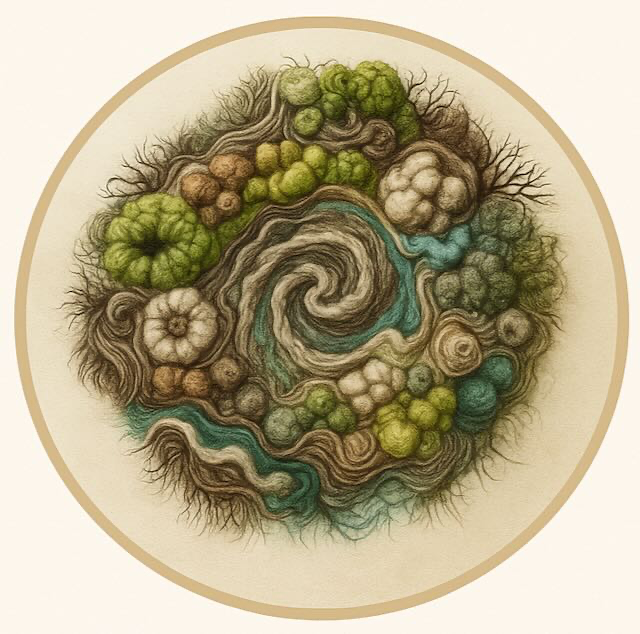
The third thread I want to pull sideways through the seasons is kinship. The first two echoes followed the body and the water, and both turned out to be continuous presences that the seasons borrowed one behaviour at a time.
Kinship behaves differently. The web of relationship never changed across the four seasons, and neither did its behaviour. What changed was my position in the exchange.
In Unravelling, the web held me
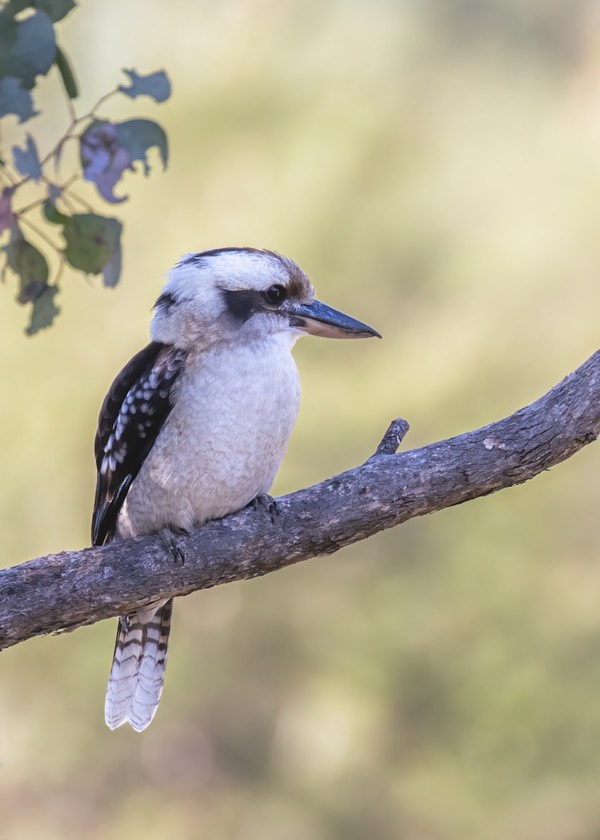
Kinship entered this work as a remembering. The semi-wild bushland that held me through lockdowns, the kookaburra who always seemed to arrive at the right moment, the shifting water and the birds: a quiet relational web surrounded me whether I noticed it or not, and the first season’s work was simply to notice.
The kinship field, as I named it then, included the more-than-human and the dead alike, all those who left stories in the water and the trees and knew how to listen long before we forgot.
What strikes me now, reading back, is the direction of flow. In that first season I had nothing to give. Things were ending, identities were composting, and the web’s whole work was to hold a person who could only receive. The practice asked for one small act of acknowledgement, a silent or spoken I see you, and even that was less a gift than a receipt.
In Drifting, the web moved with me
By the second season the web had become a travelling companion. The flotilla gathered: vessels loosely tethered, each with its own rhythm, listening to the same wind and the same tide. The flock turned in the air with no leader and no orders, coherence arising from attention alone. Kinship in the drift meant moving together without needing to be the same, staying close without collapsing into sameness, catching each other’s sentences when no one knew where any sentence was going.
The direction of flow had shifted. I was no longer simply held. I was moving within the web, alongside it, one vessel among many, and the season’s claim was that the flotilla itself remains a form of kinship even when nobody can name the destination.
In Seeding, I gave into the web
The third season reversed the current entirely. Cross-pollination became a core movement, and an offering only made sense as something placed into shared soil, into relationship, into the spaces between. Bridging rather than broadcasting, contribution rather than conquest: every small courageous act of that season was addressed to the web, the first things I had been able to give back after two seasons of receiving and accompanying.
The bee does not pollinate alone, and the season knew it. An offering travels between kin or it travels nowhere. The web that had held me and moved with me was now the destination of everything I made.
In Resonance, the web answered
The fourth season completed the circuit. Resonance kinship asked a question the earlier seasons could not have asked: who helps me sound most like myself?
The forest became the teacher, fungal threads lacing root to root beneath the soil, oak and birch each sounding their own note and each altered by the others, weaving a coherence no single species could sustain alone. The forest is harmony rather than unison, difference carried well.
For the first time, the web was audibly responding. An offering went out and something came back: a hum, a clang, an echo, a silence that itself carried information. The season’s discernment work was really a listening for the web’s reply.
The conversation, heard whole
Here is the connection I never made while the seasons were being written. Across the four seasons I learned what I can only call the four parts of one conversation: receiving, accompanying, offering, and listening for the reply.
The web spoke first, long before I had anything to say, and it was patient while I learned my part season by season. The kookaburra who arrived at the right moment in the first season was already conducting the whole exchange in miniature. She held the moment, she kept me company in it, her call was an offering I had done nothing to earn, and when I finally looked up, the looking was my first reply.
Reciprocity, seen this way, was never a transaction to balance. It was a conversation to enter at whatever point you happened to be standing, and every position in it, including the empty-handed one, was a legitimate place to stand.
A small practice lives inside this echo, and like the others it asks for nothing new. Somewhere on your ordinary route there is a kin you already half-know: the street tree you pass without looking, the magpie on the power line, the strip of green between your house and everywhere else.
The next time you pass, pause long enough to notice which direction the conversation is flowing that day. Some days you will be held, and that will be enough. Some days you will be accompanied, or you will have something small to give, or you will catch, just at the edge of hearing, the web answering something you offered long ago and forgot. Any of the four positions is a fine place to stand, and the conversation has room for all of them.
Find this in book form
The Season of Unravelling has its own home beyond Substack now. It’s the first in a four-part Almanac, the expanded long-form telling of this whole year-long inquiry, with Unravelling, Drifting, Seeding, and Resonance each becoming their own book.
This first one, The Season of Unravelling, is 59 pages: longer than a single Substack post, shorter than a commitment. It weaves the original posts into one fuller arc, with the threads, the practices, and the reflections that the weekly format never had room for. It’s currently free to read on Kindle Unlimited, or available to purchase on Amazon.
The Season of Drift, Seeding, and Resonance are still being woven into their own long-form editions, so if this one resonates, there’s more of the Almanac still to come.
The Art of Unravelling is offered as a gift, sustained by those who feel called to support the weaving. If you’d like to help tend the fabric of this work, you can contribute via the link below.