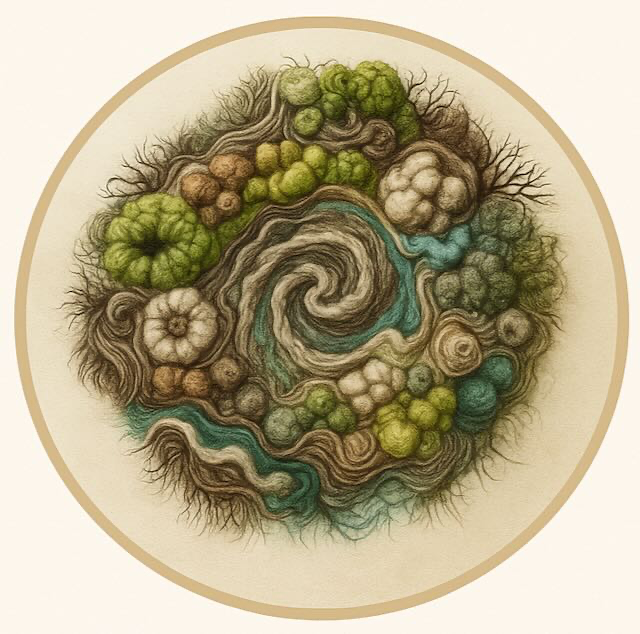

There’s personal grief, the kind we expect when someone we love dies, or when a relationship fractures, or when a life we built slips out from under us. There is also a quieter, more pervasive grief, the slow unravelling of the self when the stories that held us together no longer fit.
This week, we turn inward.
We look at the ways our personal unravelling is never separate from the larger cultural and ecological composting we are living through.
We sit with the loss of who we thought we were, the futures we once believed in, and the versions of ourselves that made sense inside a world that no longer exists.
Sitting inside the unravelling
For me, this season of unravelling began long before I could name it.
It started as restlessness: a subtle but persistent discomfort inside the roles I was holding. The futures work, the strategic plans, the desire to be useful and all of it suddenly felt brittle, hollowed out by a deeper knowing I couldn’t quite articulate.
The world I had spent so much time trying to prepare for, the world I wanted to help others navigate, was already gone, even if the systems propped up its shadow. I had been trained to map the future like it was a landscape we could cross with the right equipment. But the ground itself was disappearing underfoot.
The grief that arrived wasn’t just for the futures I had imagined.
It was for the version of myself who believed I could stand slightly apart from collapse, who thought my role was to help others prepare, rather than to fully feel what was happening. That version of me, the one who believed in expertise, strategic foresight, and the slow arc of progress, began to fray. At first, I tried to patch it back together but the harder I tried to reclaim her, the clearer it became that she no longer fit, she had served her purpose.
It was time to let her unravel.
Grieving the self as cultural work
Personal grief and cultural grief are not separate. The selves we build: our roles, identities, and professional personas, are all shaped inside larger cultural systems. When those systems begin to collapse, the selves we built inside them start to come undone.
It feels personal, but it’s also structural. For me, that unravelling has meant grieving:
The identity of the helpful expert, always ready with a plan.
The belief that if I could just find the right words, I could help others make sense of collapse.
The comfort of knowing my skillset had value inside the systems I wanted to change.
The fantasy that I could stay inside the system and still remain intact.
Grieving these identities doesn’t mean rejecting them.
It means composting them: allowing them to soften, break down, and feed whatever new self is trying to emerge. It also means grieving the ways those identities kept me safe, how they offered belonging, legitimacy, and a sense of being useful. Unravelling the self is not an intellectual exercise. It’s a bodily process, full of discomfort and vulnerability, because it touches directly on survival.
Who am I when the systems I adapted to no longer exist?
Who am I without the roles that gave me value?
These questions are not problems to solve, they are thresholds to pass through, slowly and with care.
Composting my old self
Some of this grief work can only be done alone: walking, sitting, allowing the old stories to loosen their grip in silence. Some of it needs company: a circle, a witness, a way to be held in the tenderness and mess of it all.
This season, I’m learning to do both.
To walk quietly with the grief that’s mine alone to hold, and to show up here with the fragments that might be useful to someone else. This post itself is part of that composting. Each word a thread from the old self, laid down to feed whatever comes next. Maybe this is the point of it all, to let the grief speak, even when it’s messy or uncertain or strange. To call out, not knowing what will answer.
Nick Cave writes, “The echo is not empty, not in the slightest. We call out, and given time, the echo comes back bearing the entirety of the world.”
That line stays with me, it reminds me that even in the darkest compost, during the loss, the letting go, the unravelling of self, something is listening and if I am quiet enough and still enough, I might hear the world call back.
Find this in book form
The Season of Unravelling has its own home beyond Substack now. It’s the first in a four-part Almanac, the expanded long-form telling of this whole year-long inquiry, with Unravelling, Drifting, Seeding, and Resonance each becoming their own book.
This first one, The Season of Unravelling, is 59 pages: longer than a single Substack post, shorter than a commitment. It weaves the original posts into one fuller arc, with the threads, the practices, and the reflections that the weekly format never had room for. It’s available to purchase on Amazon.
The Art of Unravelling is offered as a gift, sustained by those who feel called to support the weaving. If you’d like to help tend the fabric of this work, you can contribute via the link below.