Last week you listened for tone, the first vibration of your being. This week, we turn to tuning. Resonance isn’t permanent, it is more like a sprout breaking soil, where your early coherence is delicate. Too much noise, fear, or demand from in or outside you can pull you off.
Tuning is the art of returning, this is not about staying perfect but about coming back again and again.
Why tuning matters
Instruments never stay in tune. Temperature, humidity, handling all shift the horns, woodwinds and strings. Musicians don’t despair, they tune and the same can be true for us.
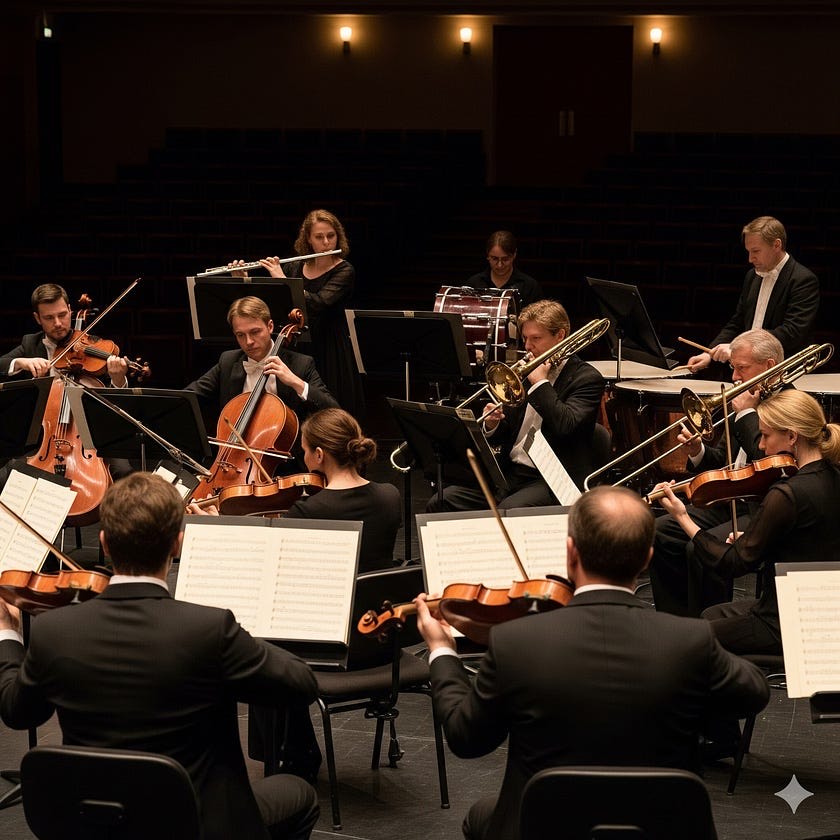
When an orchestra gathers, the very first thing that happens isn’t the music. It’s tuning. The oboe (or sometimes the concertmaster violin) plays a single note, the “A”, and every other instrument adjusts themselves to it. Without that pause, the most skilled players in the world would still sound like chaos. Tuning is what makes harmony possible. It’s not decoration, it’s foundation.
Our lives work the same way. No matter how much skill or experience we have, if we don’t take time to tune, everything comes out jagged, distorted, just a little bit off and we quickly learn that our tuning isn’t permanent.
Instruments drift, the strings stretch, the air shifts, the wood contracts and so tuning has to happen again and again, every rehearsal, every performance. The point isn’t to hold a static perfection, it’s to keep returning to coherence.
Different cultures, different tunings
Here’s another layer: even that orchestral “A” is not universal. In most of the world today, “concert pitch” is set at A = 440 Hz. But not everywhere, and not always. European orchestras often use A = 442 Hz or even 444 Hz for a brighter, more brilliant sound.
Baroque music is sometimes played at 415 Hz, a whole semitone lower, to match the instruments of the time. In India, tuning is relational rather than fixed: the tanpura drone creates a field of resonance, and the instruments and voices find their place within it. Even within Western history, “the right A” has drifted: in the 18th century, it could range anywhere from 415 to 465 Hz depending on city, church, or ensemble.
What this tells us is that tuning is always contextual. There is no one eternal “right note.” What matters is coherence within the system you’re part of. The orchestra agrees together usually aligning to those who have perfect pitch, the raga aligns with the drone.
Tuning in Our Lives
Our bodies, too, drift out of tune due to stress, fatigue, noise, or trauma. We pick up dissonance from culture, family, work and just like the instruments, we need to pause, listen, adjust.
Tuning in this sense is not weakness, it is not indulgence. It’s the discipline of alignment, a willingness to stop, check your tone, and adjust so you can play in coherence with yourself and with the field around you. Let’s assume we don’t fail when we fall out of resonance, we only fail if we forget how to return.
The practice: four ways to return
This week’s practice offers four simple entry points: breath, ground, sound, and boundary. Each is a different way to re-enter resonance when you notice yourself knocked off.
If you’ve never felt “in tune” before, that’s okay. For many people, being in their bodies feels unfamiliar, even impossible. Some people can’t feel peaceful because they can’t feel themselves. Sometimes we are all in our heads, with no clear sense of how alignment in the body even feels.
So here’s a gentle marker: being in tune doesn’t always feel blissful. It may feel like calm, steadiness, or a subtle hum. It may feel like your breath deepens, your shoulders drop, or your thoughts slow down. Sometimes it’s as simple as “a little less noise” or “a little more here-ness.” Start there. That shift is resonance.
The full Tuning practice card gives you step-by-step guidance for all four methods, plus reflection prompts to help you notice which entry point works best for you.
Reflection prompts
What most often pulls me out of resonance?
Which tuning ritual brings me back most reliably?
How do I feel when I allow myself to re-enter gently, without shame?
Re-tuning is not failure, it is a skill that improves with practice. Like the musician tightening strings, or the gardener tending soil, your task is not to stay perfect, but to return to check your attunement, again and again, until resonance becomes your habit.
The Art of Unravelling is offered as a gift, sustained by those who feel called to support the weaving. If you’d like to help tend the fabric of this work, you can contribute via the link below.