In most organisational life, we are taught to seek clarity. We create purpose statements, strategic plans, and KPIs. We are expected to move together with certainty and alignment toward measurable goals.
But what happens when the path ahead is not just complicated, but truly complex? What happens when the fog rolls in, and the maps we were given are no longer reliable? What happens when the whole system is drifting?
This is the inquiry for our times. Not just how do we, as individuals, drift, but how do organisations drift well? How do they navigate uncertainty without collapsing, without fragmenting, and without forcing a false or brittle sense of direction?
First, we must re-frame the word itself. Drift is not disorder. It is not a failure of leadership or a crisis of purpose. It is a fundamental shift in posture. To be passively adrift is to be lost. But to practice drifting is an intentional, attuned, and highly responsive state of being. It is a shift from the rigid mechanics of control to the fluid dynamics of sensing.
It is the capacity for an organisation to become porous, able to feel what’s emerging in the wider field. It is the courage to soften the grip on rigid roles and allow for new configurations. It is the skill of moving withthe unknown, not against it.
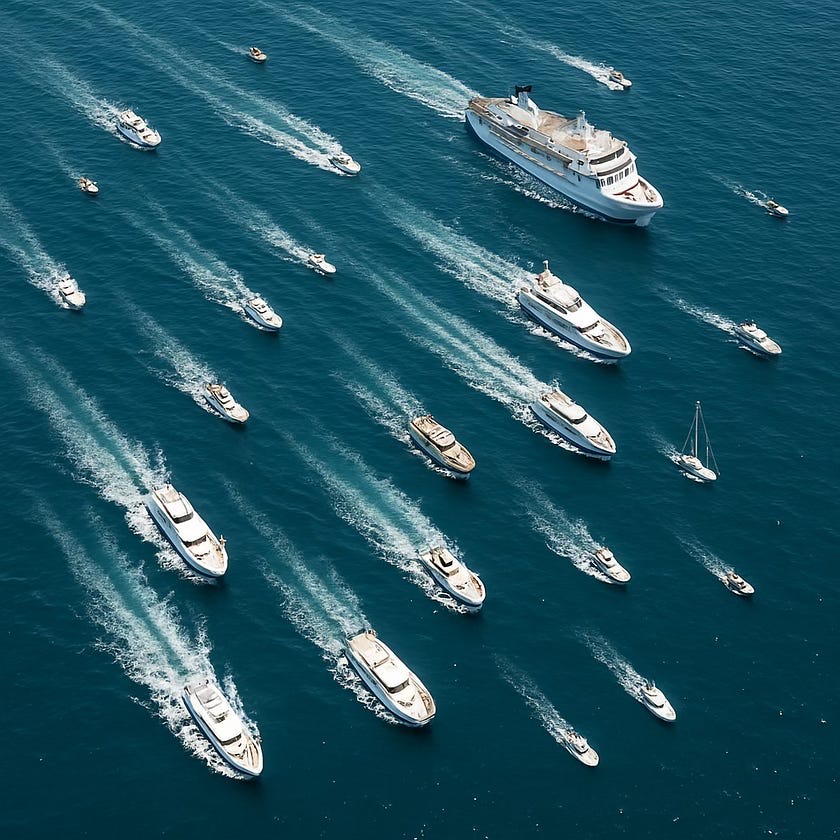
The most useful metaphor for this practice is the flotilla.
Imagine a cluster of vessels moving together on the same body of water. They are not tethered into a single, rigid structure. Each boat has its own crew, its own rhythm, its own orientation. Yet they are held together by something larger: the tide, the wind, a shared destination felt more than spoken. This is a system held together by relational gravity.
This is what it means to practice organisational drifting. It is a refusal of top-down, centralised steering. It is an invitation to sense shared directionality without enforcing uniformity. The vessels in the flotilla are in loose formation, navigating by sensing the currents more than by following a command.
To begin sensing your own flotilla, you don’t need a new strategic plan. You need a new set of questions:
Where in our organisation is drift already happening, whether we name it or not?
What rigid roles or rhythms are beginning to loosen?
What if this “lack of clarity” is not a problem to be solved, but a seasonal state to be navigated?
What if our purpose is not a fixed point on a map, but a fluctuating tide we must learn to read?
This is not about abandoning direction. It is about shifting how we find it. We move from strategy to sensing, from performance to relational attunement, from command to constellation. We stop asking, “What’s our next deliverable?” and we start asking, “What is the field trying to do through us right now?”
This is the work. To stand on the deck of your own vessel, feel the current beneath you, and watch the other boats in the distance, trusting that the flotilla is still a form of kinship.
Next week, we will enter the map room together. I will share a practice called Flotilla Orientation, a deep, relational process for making the map of your own flotilla visible. It is a way to do this sensing work together, with care and intention.
The Art of Unravelling is offered as a gift, sustained by those who feel called to support the weaving. If you’d like to help tend the fabric of this work, you can contribute via the link below.