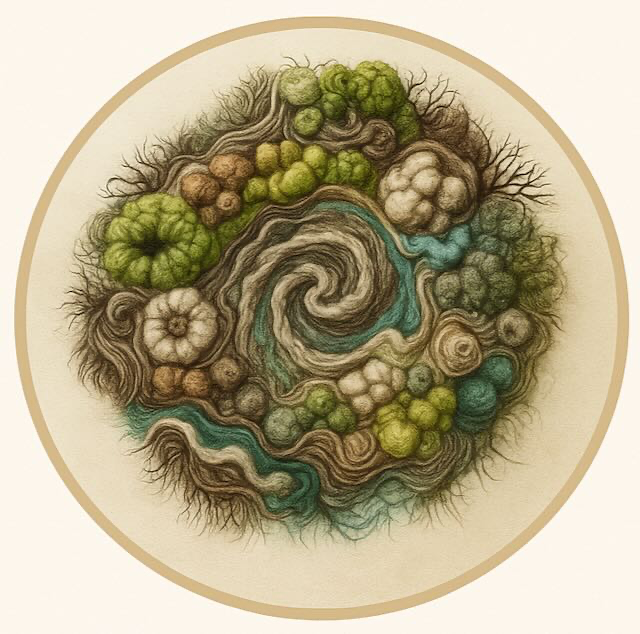
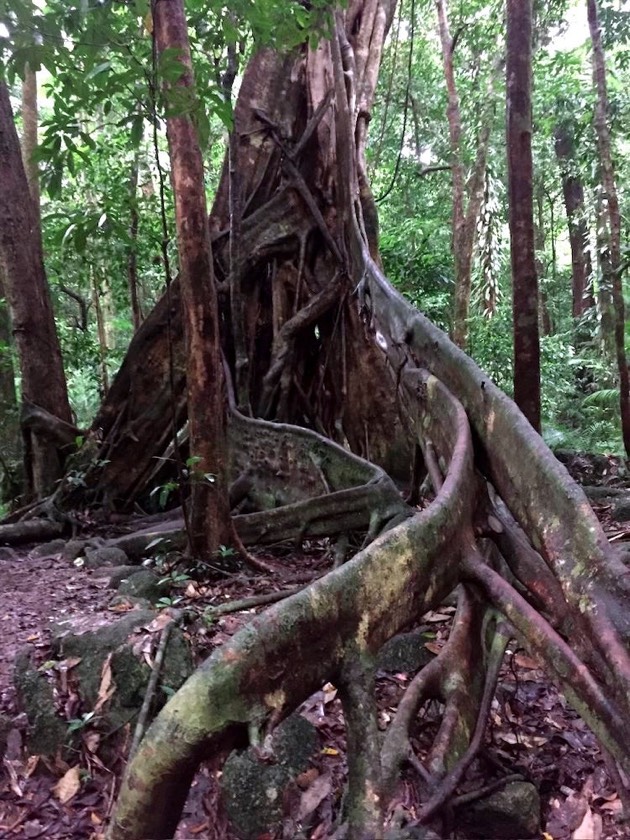
Roots grow down before branches grow out. They thicken quietly, testing the soil, making a home in its minerals and moisture before they send anything above ground. This is the work we’re in now: not the sudden leap, not the quick flourish, but the slow, deliberate reach. Not bigger for its own sake, but truer and more connected. We want more integration with the ground we stand on.
From tiny offerings to tending rhythm
Earlier in the season, we made tiny offerings: a phrase, a gesture, a seed placed on the table between us and another. They were acts of curiosity and courage, small enough to try without fear of losing too much. This week, we’re not scaling up in the way the dominant culture teaches with more reach, more visibility, more audience. Instead, we are rooting into rhythm: making offerings in ways that deepen relationship, honour the ground we’re on, and begin to form part of a living ecosystem.
When I started this Substack it was tempting to check every day how many people read the posts, where they came from and whether they came back. By doing this, I was left with some choices: what made a ‘good’ number of readers, what ‘should’ I expect? These choices are not value free, and I found them impossible to make without being polluted by the trappings of modernity where bigger is better.
I had to sit with the idea that doing the creating was more important than the product. I landed in a place where I don’t care how many people read this work, what I care about is doing the best work I can. The development of a practice of thinking, writing, creating and packaging my ideas is my offering. I iterate and develop it over time, and I am experiencing joy in the doing, so much joy.
What changes now
We iterate from one-off to ongoing: choose something you’ve already offered and return to it, again and again. We shift from tentative to steady: try to keep the gesture the same size but make it consistent. If at all possible, try to open up by moving from solitary to relational: let the offering breathe with others and tend the soil around it, not just the seed itself.
Why slow matters
We know from the world around us that quick growth often leads to shallow roots. The world we’re in now is full of offerings that shoot up quickly but cannot hold their own weight when the wind comes.
A slow reach lets your roots thicken. It builds trust, both in yourself and in the relationships your offerings touch. It gives the ecosystem around you time to adjust, to make space for what’s arriving.
A note from Atomic Habits
James Clear reminds us that “You do not rise to the level of your goals. You fall to the level of your systems.”
A habit sticks not because we decide to “try harder,” but because we make it:
Obvious – place a visual or environmental cue where you’ll see it.
Attractive – connect it to something you already enjoy.
Easy – keep the action so small it’s hard to skip.
Satisfying – close each act with a small moment of reward or recognition.
Habit stacking is one of his simplest tools:
“After I [current habit], I will [new habit].”
It ties your new practice to something you already do automatically.
For example:
After I make my morning tea, I will spend two minutes tending my offering.
After I check my email, I will send one small message of care or follow-up.
After I pick up a parcel or letter, I will notice what needs tending in the garden.
By stacking the new practice onto an existing habit, you let the rhythm of your life carry it forward.
Mycelial Reaching
Fungi teach us something about slow reach. Beneath the forest floor, mycelium threads out in patient tendrils, testing the soil grain by grain. They don’t rush to fruit. They send filaments quietly, sensing conditions, forming relationships, exchanging nutrients, building trust with the roots they touch.
Merlin Sheldrake (Entangled Life) describes this as a kind of subterranean entanglement:
Mycelium is how fungi explore. They insinuate themselves into their surroundings, entangling themselves with the lives of others, weaving worlds into being.
What looks like nothing happening is actually the foundation of everything. Mushrooms may fruit quickly, but only after days, weeks or years of invisible mycelial weaving. Our offerings work the same way. The slow reach is not wasted time. It is the relational ground-building that allows anything enduring to emerge.
Practice for the week: A Daily Act of Tending
Pick one seed, something you’ve already offered, and spend a little time with it each day. This could be:
Adding a line to a piece of writing you began weeks ago.
Returning to a conversation to see where it’s grown.
Spending time in a place you’ve been tending, and making one small gesture of care.
Checking in with someone you offered to and asking what’s happened since.
Make it obvious, attractive, easy, satisfying and, if it helps, stack it with something you already do every day. Let it repeat enough that it becomes part of the root system of your life.
Additional Practice: Seed Sack Inventory
If you have the Seed Sack Inventory, then this week would be a good time to dip into the Seed Whispers process where you listen into your seed and what it wants to tell you. You might also want to take a look at the Ikigai for My Emergence if your seeding process is a bit stuck.
Reaching doesn’t have to mean stretching for the horizon. Sometimes it means extending just far enough to touch the next root, the next thread, the next patch of ground and doing it often enough that connection becomes part of the landscape.
The question is not: How much can I offer?
Instead, it is: How can I keep offering in a way that holds?
The Art of Unravelling is offered as a gift, sustained by those who feel called to support the weaving. If you’d like to help tend the fabric of this work, you can contribute via the link below.