Organisations like people, cultures, and ecosystems, are shaped by loss. When strategies fail, roles dissolve, people leave or collective dreams fracture, the ground beneath an organisation shifts, but rarely is that shift acknowledged for what it is: grief.
What we often call “change management” is, at its core, a process of collective grief and one that is too often unspoken, too rarely tended. The formalities of offboarding plans, restructures, or project closures tend to skim over the deeper, more personal and relational losses: the loss of meaning, the frayed threads of belonging, the quiet mourning for futures that will never arrive.
This is a book about grief, about its many moods and movements, shapes and textures. It is about how sorrow carves riverbeds in our soul, deepening us as it flows in and out of our lives.
There is something familiar about the rising and falling of loss, how it takes us below the surface of our lives and works on us in some alchemical way. We are remade in times of grief, broken apart and reassembled.
(Francis Weller, The Wild Edge of Sorrow, page 1)
What if the same was true for organisations? What if organisations, especially those sensing the edges of their usefulness, could allow themselves to be remade by grief, instead of racing to reinvent themselves in ways that deny the loss beneath the surface?
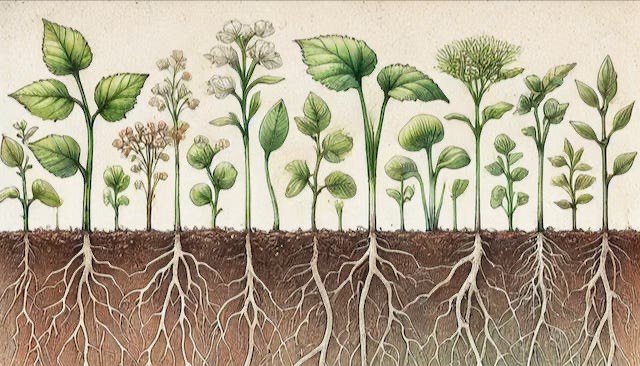
Inside organisations, grief accumulates in the spaces between formal processes: in the loss of projects that once carried hope, in the disbanding of teams, in the quiet exits of beloved colleagues, in the moments when the organisation's values and its actions parted ways. This grief doesn’t disappear, it settles into the culture like silt after floodwater, becoming cynicism, disengagement, or quiet withdrawal. If untended, the relational soil hardens, making it difficult for anything new to root.
Reducing separation by remembering we were never apart
Bringing organisations back into relationship with the living world isn’t about inserting something new. It’s about remembering what’s already true, that every decision, product, service, restructure, or project is already woven into a wider fabric of relationships. The ways we work; how we gather, how we create, how we end things either deepen our sense of belonging to that fabric or sever it further.
Soul returns to the world when we attend to the rhythms of nature, when we nourish our friendships with time and attention, and in our daily participation with repairing the world.
(Francis Weller, page 2)
We might not bring this language into a leadership meeting (and we should), but the truth remains: every act of work either feeds or frays the threads between us and the living world. The walls we build between “work” and “the world” are an illusion, the work has always been part of the world.
What would shift if organisations understood themselves not as separate from the living systems around them, but as temporary ecologies of attention, action, and relationship nested inside watersheds, cultural currents, and ecological realities?
What if grief for projects, roles, and ways of working were treated not as failure, but as part of the cycle, composting what’s complete to nourish what’s next?
Turning out the lights - a reflection on endings
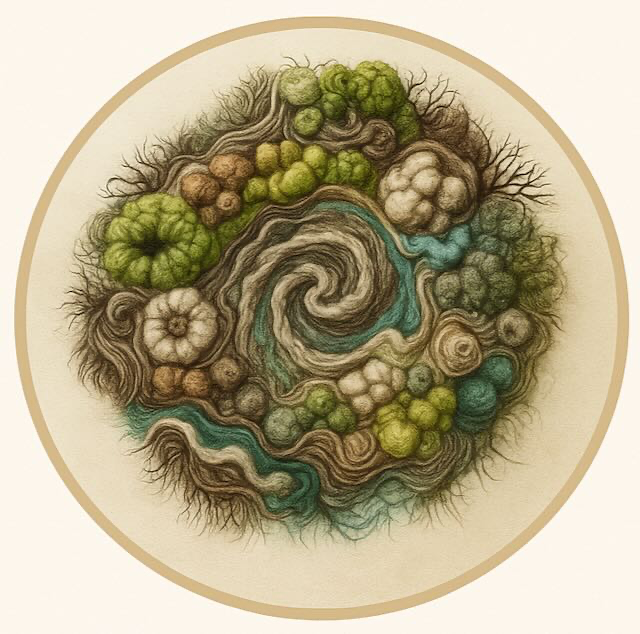
We were a temporary tangle: a team brought together to hold the edges of change, to wander into the uncertain space between how things had always been done and how they might be done differently. We were, in a way, a floating mat of roots which were not yet fully anchored, but weaving together just enough solidity to catch what might drift past.
The work had seasons: the first year was tender, exploratory, sending out thin filaments to see what might take hold, by the second year, we had shape. We were making things that mattered, not just products and processes, but relationships, ways of being together, ways of seeing the whole organisation as something alive.
As they change, systems don’t like too many root systems forming at once. When a larger, enterprise-wide transformation was declared, a sweeping shift to how services were delivered, we were gently and then firmly unthreaded. Our work was composted into the soil of that new program. The team, once tightly felted together, began to unravel.
There was no formal process for this, no ritual for disbanding a root system, no tide table for floating apart. To ‘manage the change’, messages were drafted and approved then chats were had with ‘affected people’, organisational charts altered, reporting lines changed and finally announcements made to the wider group. This was best practice, we were well communicated to and clear plans for transition were developed.
However, our team knew instinctively that what was ending needed tending, so we made our own ceremonies. We gathered in small circles to name what we’d made together; raised quiet toasts in corner booths; wove the memories into long conversations about what we’d learned, who we’d become. As the fibres pulled apart, we didn’t cling. We let the felting loosen, knowing that trying to hold too tightly would only tear the weave. We attended to the fibres in-between, not just the visible structures, we laid our relationships to rest and let go of all the plans we had for the future and tried to work through the emotions.
One after another, people left to the new program or to other places, and I stayed, the last root in the mud. The one who turned out the lights, watching the tide come in and reclaim the ground we’d briefly held. There was pride in what we’d made, but also a grief I didn’t yet have language for. The system didn’t ask for my grief, so I carried it quietly, pressed into the layers beneath my work face. I had held the space for others to release themselves and in the holding, I was yet to let go.
The next program grew well enough. It was a different system, with different roots, one I belonged to briefly, then not at all. My role became redundant, while many of the people I’d worked alongside stayed and built something beautiful in its own right.
There was no tragedy in that, just the natural logic of systems shifting, the tides moving on, but my grief was real, unnamed and I needed time to work through the layers. I burned out not long after, not just from the work of ending in a culture that does not value such activity, and from the unspoken weight of everything that followed holding such a space.
Still, what I remember most isn’t the emotional exhaustion, it’s the way we chose to end with care knowing that how we unravel matters as much as how we begin. We didn’t fight the drift, we let it carry us apart, trusting that some threads would find each other again, somewhere downstream. What I learned is that we need to speak about this process, name it and bring it out of the shadows. This helps us move through the emotions, let go and move into the next space we asked to inhabit.
Endings aren’t failures, they are part of the felted weave, the fibres pulling apart so something new can press in. Having rituals that support us to navigate them builds our ability to let go and move on.
Reflection
What has your organisation lost in the last year: projects, people, stories, relationships?
What was mourned quietly, or not at all?
What might shift if your organisation gave that loss a place, not to fix it, but to honour it?
Find this in book form
The Season of Unravelling has its own home beyond Substack now. It’s the first in a four-part Almanac, the expanded long-form telling of this whole year-long inquiry, with Unravelling, Drifting, Seeding, and Resonance each becoming their own book.
This first one, The Season of Unravelling, is 59 pages: longer than a single Substack post, shorter than a commitment. It weaves the original posts into one fuller arc, with the threads, the practices, and the reflections that the weekly format never had room for. It’s available to purchase on Amazon.
The Art of Unravelling is offered as a gift, sustained by those who feel called to support the weaving. If you’d like to help tend the fabric of this work, you can contribute via the link below.