“Ghosts are not always dead people.” Nora Bateson
We begin not by planting, but by pausing. Not by visioning, but by listening because the soil is not silent. It holds memory, grief and trauma: personal, ancestral, cultural, ecological. It holds the early stirrings of what comes next if we are willing to listen without rushing to act.
This first week of the Season of Seeding is not for activity. It’s for attunement to the ground beneath us, both literal and metaphorical, and to what it’s carrying, remembering, resisting.
Listening for Ghosts
Nora Bateson
Nora reminds us that the systems we move within and try to transform are shaped by ghosts: unfinished business, inherited patterns, invisible scripts. Ghosts are what we carry without realising we carry them. They haunt the way we build, relate, seed, and speak. And often, we try to plant something new without noticing what’s buried underneath.
Ghosts might be:
The pressure to “be useful” or “get it right”
The myth of independence
The trauma that says “it’s not safe to be visible”
The echo of colonial logics: scale, control, certainty, speed
Listening to the soil means noticing these ghosts. Not to banish them, but to greet them. To name the stories beneath our seeds.
Trauma, soil, and emergence
In trauma-informed healing, we learn that the body holds what the mind forgets. So does the land, and our institutions, identities, and intentions. Before we can seed anything with integrity, we must ask:
Is this soil safe for this seed?
What needs to be felt, metabolised, or grieved before anything can grow?
Whose grief am I carrying that might not be mine?
This is the decolonial practice as relational ethics. The Onion Collective reminds us: systems change cannot happen without grief and place-based honesty. We cannot reimagine without acknowledging what the current soil has cost us and others.
Voices that echo this listening
Sonja Bignault
Sonja’s patterning work reminds us to notice the field not just the seed, to become aware of the often-invisible forces that shape how ideas, identities, and systems come into being. Sonja reminds us that soil is not just a metaphor, it is the relational and systemic field we move through. Unless we tend the field through presence, pattern literacy, and deep noticing we may continue to plant into depleted ground. What shapes the soil? What conditions we don’t speak about shape what can or can’t grow?
Bayo Akomolafe
“The times are urgent; let us slow down….(and) The cracks are not where things break down. They are where the new thing slips in.”
Soil does not shout, it waits, it remembers and sometimes, it refuses to grow what we are not ready to tend.
David Whyte
“Start close in. Don’t take the second step or the third. Start with the first thing close in, the step you don’t want to take.” This week is that step, the one that doesn’t look like progress, but changes everything.
Vanessa Andreotti
Vanessa’s work, especially through the Gesturing Towards Decolonial Futures collective, reminds us that not all soil is ready for planting, and not every impulse toward repair is actually relational. One of her metaphors is the compost toilet, the scent of unsanitised grief invite us into a deeper kind of listening. One that doesn’t seek immediate growth, but instead honours composting as a long, cultural, and intergenerational process.
Tend your soil
This week is for noticing the soil you’re in, but noticing is not neutral. It’s a form of relationship that asks us to stay with complexity long enough to feel what’s truly here.
You are not the seed yet. You are still the soil, and soil, even when still, is doing subtle, vital work.
Tend Your Soil is a 1-3 hour practice of inner field mapping. It guides you through five territories: compacted soil, weeds, fallow fields, depleted soil, and living loam. You notice what’s overused, what’s inherited, what’s resting, what needs care, and what’s still fertile.
This practice is not offered here as a step-by-step walkthrough. It’s held as a contained space you step into deliberately, one that asks for time, materials (candle, earth, colored pencils, paper), and the willingness to see your ground without rushing to fix it.
If you feel the pull to stop reading and enter the work itself, you’re invited to step into Tend Your Soil.
Let this week be for tending by noticing: not rushing, not resolving, not redesigning. Just listening closely to the field you’ve landed in. Not to erase the ghosts, but to recognise their voices and walk forward with more clarity about who you’re planting with.
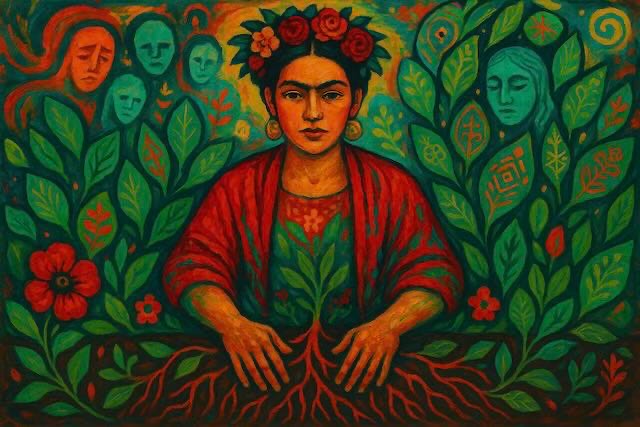
Artist’s Note – In homage to Frida Kahlo
The image at the top of this piece is a tribute to the enduring spirit of Frida Kahlo: her fierce presence, her deep entanglement with pain, beauty, and nature, and her unapologetic self-expression. Inspired by her iconic visual language and rooted symbolism, I sought not to replicate her, but to converse with her legacy.
The central figure, crowned with flowers and anchored by roots, is a gesture toward ancestry, regeneration, and the quiet strength of becoming. The surrounding foliage holds echoes of collective memory. Faces of the past, the unseen, the grieving, the growing. In making this work, I honour Frida’s power as an artist and cultural ancestor. Her influence is not borrowed here, but deeply acknowledged, an offering of reverence, not replication.
The Composting Mind - we pay to use AI and we support the payment of royalties to creators whose work is used to train LLMs.
The Art of Unravelling is offered as a gift, sustained by those who feel called to support the weaving. If you’d like to help tend the fabric of this work, you can contribute via the link below.