Week 1 - Grief as cultural work
This is the first season in a four season practice called The Art of Unravelling. This is a seasonal practice of rewilding, mourning, and emergence. Each season asks something different of us. This first one, the Season of Unravelling, invites us to sit with endings, not as problems to solve, but as thresholds to cross.
For the next three months, we’ll be tending the work of letting go, listening for what’s dying, and noticing what might quietly want to root in the softened ground. This isn’t about finding solutions. It’s about learning to witness collapse without turning away, and learning to hold grief without rushing to fix, explain, or polish it into something more comfortable.
This season is personal, cultural, and ecological all at once. It’s where I’m beginning with my own grief, my own complicity, and my own sense of the water I swim in.
Grieving modernity, grieving myself
What if we could become comfortable with the idea that death comes to us all not just our own small personal deaths, but the death of the civilisational systems we were raised to believe were permanent? What if modernity itself is already in palliative care, a system so exhausted by its own contradictions that its survival now causes more harm than its passing?
What if our role isn’t to save it, but to help it die with as much grace as we can while standing beside those who are already tending the first fragile roots of what comes next?
I am implicated in the harm modernity causes. It is the water I swim in, and if I want to be part of its composting, I need to learn how to see that water and to feel it against my skin, to notice how it shapes my thinking, my actions, my sense of what’s normal or possible.
If I cannot come to terms with my own death, how can I possibly come to terms with the death of the system that made me? What does it mean to grieve the collapse of a world where I’ve sometimes thrived? How do I let go of the comforts and identities that this system gave me? How do I let come whatever wants to root in the soil of collapse?
Even deeper: how do I stand beside those already seeding the future without assuming they need me there? What if my role isn’t to lead or even to help, but simply to learn how to stand with grace in my own unravelling?
Hospicing systems and holding space for what’s next
There’s a larger cultural question here, too. How do we hospice the systems and stories that no longer fit, in ways that allow those left behind (especially younger generations) time and space to process what’s passing? How do we avoid offloading our unresolved grief onto those who are still trying to build lives inside a system that’s collapsing under their feet?
If the rage we see exploding through identity politics right now is any clue, this won’t be gentle. If letting go is forced from above, it will feel like theft and that anger will have nowhere to go but inward, or sideways, into more fracture.
I don’t have answers. I’m only just starting to see the edges of the questions. But I do have some experience in doing this work on myself, and alongside others, sitting together inside the composting of our own stories and selves.
I’ve often done that work alone, because I can and because solitude is a privilege I can claim, paid for by the invisible labour of others. That, too, is part of the grief.
Climbing down from the scales
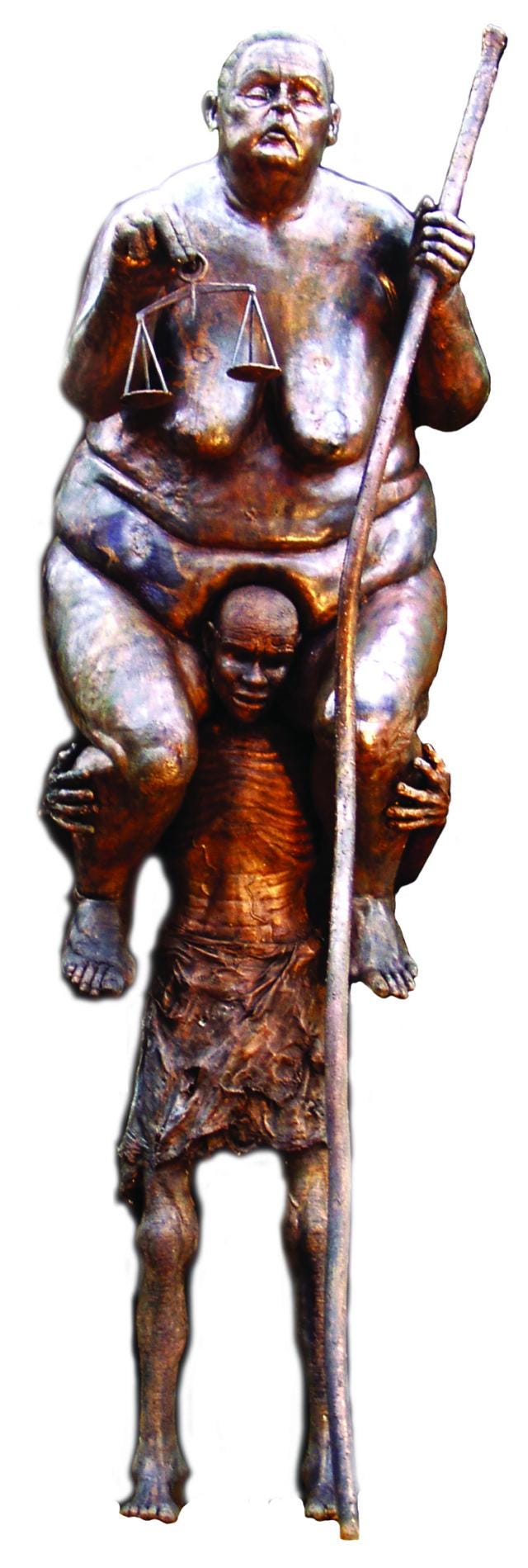
I keep thinking about Jens Galschiøt’s Survival of the Fattest: the sculpture of the blindfolded white woman balanced on the back of a starving Black man, holding the scales as if she’s the neutral weight.
I am her.
We are her.
Even when we don’t want to be.
Climbing down isn’t a solo act. It’s not a gesture of personal redemption. It’s part of a collective unravelling, where the only way to survive with dignity is to link arms with the ones we’ve been standing on and move forward together, not as saviours, but as kin.
Step 1: Learn how we got here.
Step 2: Develop a practice of composting ourselves, not just our opinions.
Step 3: Speak about it, even when it’s awkward and unwanted.
Step 4: Keep going.
Becoming unfit for a dying world
I’ve started talking about this, and more often than not, I sound completely unfit for the world I live in. The words come out heavy, damp with compost, too raw to fit neatly into strategy meetings or professional gatherings. I can feel myself becoming unfit for this society and I don’t know yet what kind of future might exist where I can be at ease with myself, with the people I love, with the truth of where we are.
Maybe The Art of Unravelling which is this seasonal practice of grieving, rewilding, and emergence is how I begin to find that out and maybe this is how we all begin to find out, together.
Find this in book form
The Season of Unravelling has its own home beyond Substack now. It’s the first in a four-part Almanac, the expanded long-form telling of this whole year-long inquiry, with Unravelling, Drifting, Seeding, and Resonance each becoming their own book.
This first one, The Season of Unravelling, is 59 pages: longer than a single Substack post, shorter than a commitment. It weaves the original posts into one fuller arc, with the threads, the practices, and the reflections that the weekly format never had room for. It’s available to purchase on Amazon.
The Art of Unravelling is offered as a gift, sustained by those who feel called to support the weaving. If you’d like to help tend the fabric of this work, you can contribute via the link below.