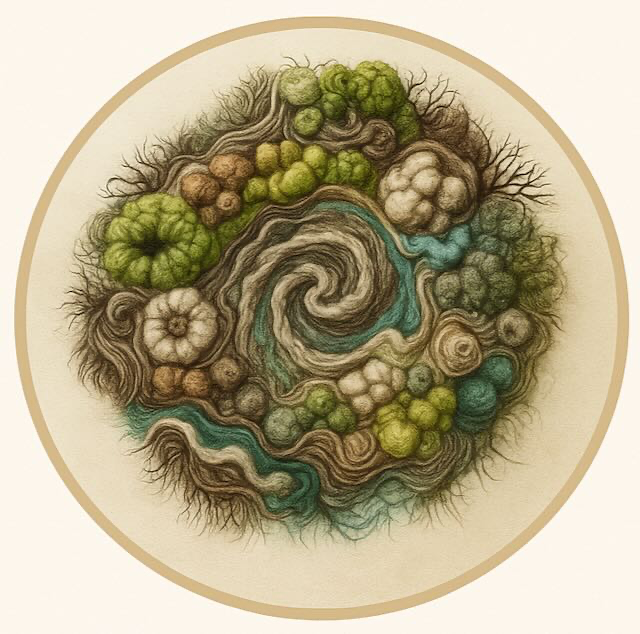

To speak of regenerative cultures is to step into complexity. It sounds simple: a culture that regenerates itself, becomes life-affirming and coherent but this work is not easy as it requires us to hold multiple threads at once, and to resist modernity’s reflex to flatten them into one neat solution.
Culture is not something you can design on a whiteboard. It is the lived resonance of a people with each other, with place, with time. To shift culture means to engage not only with what we dream of, but with what is already here: the rotting structures of modernity, the soil that holds us, the seeds that have been waiting all along.
Three threads of regenerating culture
1. Naming what is rotting
We live inside a supra-system (modernity) that is decaying around us. To even imagine regeneration, we must be able to identify what is collapsing.
Which systems are extraction dressed up as progress?
Which traditions or policies are husks, propped up only by habit or fear?
Where are we pouring energy into keeping something on life support that has already lost its coherence?
This is hospice work, compost work because regeneration begins by naming what is rotting.
2. Knowing the soil we stand on
A forest after fire is not empty. Charred trunks stand, roots run deep, seeds crack open in the heat. Some structures endure and hold potential; others must fall away.
Regenerative culture doesn’t arise from a blank slate, it grows from soil already holding memory, story, kinship. To create space for new life, we need to know:
What has survived the fire?
Which structures, even if scarred, still hold life?
What is the fertility of this soil, and what does it want to feed?
Not every remnant will fruit, but some will. Regeneration means tending what remains, not discarding it in the rush to start over.
3. Resisting the urge to manufacture the new
Modernity teaches us to equate culture-building with invention: to design something novel, brand it, scale it, claim it as ours but a regenerative culture may not require us to create at all.
Often, it is about clearing away what suffocates by burning down what is toxic, composting what is finished so that seeds already lying dormant can finally emerge. Some of these seeds are ancient: Indigenous knowledges, earth-based practices, ways of kinship suppressed by colonialism and racism but never extinguished. Others are freshly sown, fragile but alive.
The work is less about invention than about recognition, protection, and space-making.
Tending more than survival
To speak of regeneration is to speak of care. It is not enough to keep something alive at the most basic level. Survival is important, but regenerative culture asks more of us: to notice what is needed for flourishing.
It is like tending a newborn. Keeping the baby warm and fed is vital but it’s only the beginning. To truly nurture life, you need to prepare the space, provide nourishment, clothe it, comfort it, hold it in relation and even then, you cannot do it alone. Others must gather: kin, community, caregivers.
Regenerative culture is the same. We cannot only patch the systems we have so they limp along. We need to ask: what does this fragile new life need in order not just to survive, but to grow? What structures must be composted to make space? What remnants of soil can support it? Who else must be present in the circle of care?
Regeneration is not about doing everything ourselves. It is about offering what we can (deeply and generously) and trusting that others will join the weave.
The difficulty of collective harmony
Harmony at this scale isn’t about everyone singing the same note. It’s about creating a field where many voices, many histories, many truths can coexist without collapsing into noise or domination. That means facing into colonial legacies, systemic racism, and the violence embedded in the structures we’ve inherited.
Talking about harmony and regeneration is easy. Doing the work requires patience, humility, and a willingness to face what is uncomfortable. It is not a quick fix, it is a practice of tending complexity and trusting that coherence can emerge, slowly, from the weave.
The Rot-Soil-Seed Map
To navigate this complexity, we need a way to locate ourselves within the living process of change, not as planners or fixers, but as participants in the ecology of transformation.
The Rot-Soil-Seed Map is a reflective mapping practice that helps you sense where you stand:
Rot: What structures, habits, or stories are decaying around you?
Soil: What remains, scarred but still alive, that could nourish new life?
Seed: What long-dormant possibilities are breaking open?
This isn’t a strategic plan. It’s a way of listening to the field you’re already in, noticing what’s asking to be composted, what’s asking to be tended, and what’s quietly trying to emerge.
The practice takes 30-45 minutes and includes a meta-reflection process to help you notice the balance of your map: Are you grieving? Rushing to invent? Standing on fertile soil?
This practice is not offered here as a public walkthrough. It is held as a contained space you step into deliberately, one that asks for pen, paper, and the willingness to name what you’ve been avoiding.
If you feel the pull to stop reading and enter the work itself, you’re invited to step into The Rot-Soil-Seed Map.
A regenerative culture is not built by blueprint. It is woven from endings, remnants, and seeds. It requires the courage to face what is dying, the humility to stand on the soil we have, and the restraint to make space for what has been waiting to emerge. Harmony here is not the absence of tension, but the presence of a field strong enough to hold it.
The Art of Unravelling is offered as a gift, sustained by those who feel called to support the weaving. If you’d like to help tend the fabric of this work, you can contribute via the link below.