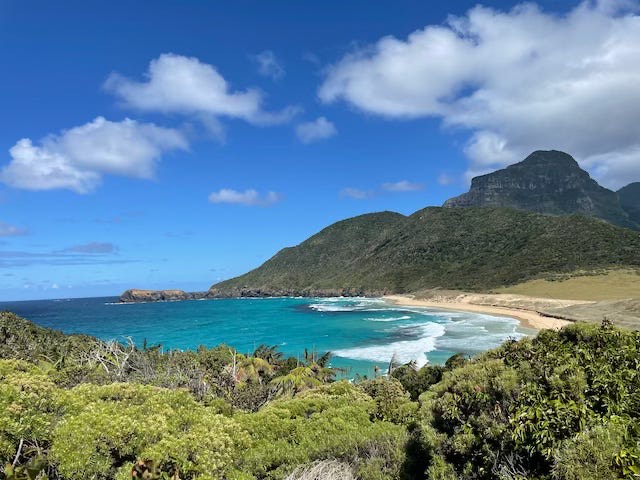
We had been moving fast.
From Melbourne to Sydney, Sydney to the island, from the air to the water, from the world of schedules and expectations to a place that doesn’t care what time it is. Lord Howe isn’t a place you arrive at so much as a place that reveals itself at its own pace, if you’re willing to slow down enough to notice.
And yet, even here, I saw the same pattern play out.
People conquering the mountain.
There’s a walk on the island, an ascent on Mount Gower which is an eight-hour climb, near vertical at points, hands gripping ropes, feet scrambling over rock. People push themselves to do it, then come down, flushed with pride, as if the mountain was something to be achieved, rather than encountered.
I’ve felt that same impulse in myself.
To measure progress by what I’ve done, not by how I’ve moved. To reach the end of the day and ask: What have I accomplished? instead of What have I noticed?
It made me wonder:
What happens when movement isn’t about getting somewhere, but about listening to where you are?
This question was still with me when I recorded a recent episode of FuturePod X.
We spoke about Letters to the Future: the idea that everything we do, everything we leave behind, is a letter. Every system we uphold, every way of working we reinforce, every choice we make is an imprint on what comes next.
Some of these letters are written in ink. Others are written in soil, in policy, in culture, in how we show up for each other. But what struck me most, in that conversation, was this: we are not writing these letters alone.
The future is relational.
It isn’t something we predict or control. It’s something we shape in relationship: through kinship, through listening, through knowing we are not separate from what comes next.
Listening for what’s emerging
I found myself in the ocean, opening - it wasn’t a prayer exactly, and it wasn’t a request. It was just a softening, a loosening of the edges, a willingness to be in conversation with whatever wanted to meet me there.
I didn’t call the dolphins, but they came. A pod that hadn’t been seen for weeks, rising alongside the boat, skimming the water’s surface, close enough to feel their wake.
Coincidence, probably.
But what if it wasn’t?
What if the world responds to us, not because we are powerful, but because we are part of it?
What if sensing or opening allows us to become available to what is already moving toward us?
What if the future is already speaking, already moving, already drifting toward us, if only we learn to notice?
Working without a map
We don’t often choose to drift
Drifting usually finds us when the map disintegrates: after loss, endings, or the compass breaks in our hands. It’s not a mode we’re trained for…it doesn’t look like leadership…it doesn’t sound like progress, but it might be the truest response we have to this moment.
This isn’t just about the ocean, this isn’t just about me, it’s about how we move through the world and how the systems we’ve built refuse to move with it.
Organisations are built to drive, they set targets, force change, and try to control outcomes. They react to crises because urgency makes action feel justified, but they struggle to see the slow shift beneath their feet. They don’t notice how behaviours are changing, how people no longer want what they used to, how entire cultures are drifting toward something else…something unspoken but real.
So, they cling to the mountain. They keep climbing, thinking if they just try harder, plan better, optimise more… they can reach the summit and claim success.
But what if the path isn’t up, but out?
What if, instead of chasing the future, we let the future reveal itself like an island through mist, like dolphins rising out of dark water?
To drift is not to give up. It’s to move differently, to move with the tide, not against it. To notice what’s emerging before it has language and to become available to the world again.
In this season, we’re not mapping terrain. We’re letting the terrain re-map us.
We’re not seeking answers, we’re learning how to listen for the call and response between body and world, question and tide, self and kin. There’s no linear path here but there is rhythm.
There is relationality.
There is drift.
The drift is already happening
The question isn’t whether we can control the future. It’s whether we are willing to be in conversation with it. To move differently, to notice what’s shifting before it demands our attention and to let ourselves drift, rather than drive.
This isn’t passivity, its relational movement, the difference between pushing against the current and swimming with it. Between forcing a plan and following a pattern, between reacting to crisis and listening to emergence.
What are you sensing?
Maybe the future isn’t something we force into being, maybe it’s something we recognise by feel.
A shift in the current.
A longing in the bones.
A word that arrives on the breeze.
If the tide is moving in you, let it and if something calls to be spoken, you’re always welcome to write back.
The Art of Unravelling is offered as a gift, sustained by those who feel called to support the weaving. If you’d like to help tend the fabric of this work, you can contribute via the link below.