There’s a kind of stillness that comes at the end of a long cycle, a stillness of completion that feels like the hush that falls after the song has found its final note and still vibrates in the air.
This is where I find myself now.
After four seasons of unravelling, drifting, seeding, and resonating I have had the remarkable experience of this one year of writing, composting, grieving, and listening. It has been intense and marvellous and it now feels right to pause, to take a breath, to look back at what this has been.
How it began
The Art of Unravelling began as quest for more joy in my life and an orienting question:
What if the grief we feel (personal, cultural, planetary) is not a problem to solve, but a teacher to stay with?
At the time, I didn’t know where that question would take me. I only knew that the systems I had been trained to serve whether strategic foresight, organisational change or leadership development, they felt brittle. I could sense that something larger was dying, and that no amount of planning or optimism could make it otherwise.
So I began writing, at first it was tentative and halting. I was sitting in the mess of endings, learning how to listen to what was falling apart. Slowly, over time, a shape emerged which was not linear, but messy and mostly cyclical. What emerged was a living practice held across four seasons:
Season 1 – Unravelling: Hospicing the old stories, grieving the selves and systems that no longer fit.
Season 2 – Drifting: Learning to move without a map. Trusting emergence, surrendering to tide and time.
Season 3 – Seeding: Touching ground again. Offering what’s alive, however cracked or incomplete.
Season 4 – Resonance: Finding coherence. Letting the inner note sound in the outer world.
Each season became a way of being in the world and a record of my connection to source and the emergence of my unique spark of universal loveliness.
What I learned
The wisdom that came through this work is old, enduring, and rooted in the planet itself. It’s not mine, it belongs to the soil, the ancestors, the waters, and the kinship field that holds us all.
If I can touch it from here, sitting in the suburbs of a city at the bottom of the world, then anyone can. If it is possible for me to listen, to feel the hum of connection that runs beneath the noise of modern life, then perhaps it is still possible for us to remember what it means to belong.
Still…it has not been simple.
There are guardrails around this kind of knowledge that I had to find through respect, humility, and care. Indigenous peoples have carried this wisdom far longer and deeper than I can understand, and it is not their work to teach or heal us from the systems that harmed them. That is our work: the work of deconstructing, dismantling, and composting the structures that placed some in dominion over others.
What I have learned is that this unravelling is both personal and collective. It is messy, contradictory, full of paradox. It is not about disempowering anyone; it’s about standing with, making space, and remembering that all eight billion of us have a part to play in the reweaving.
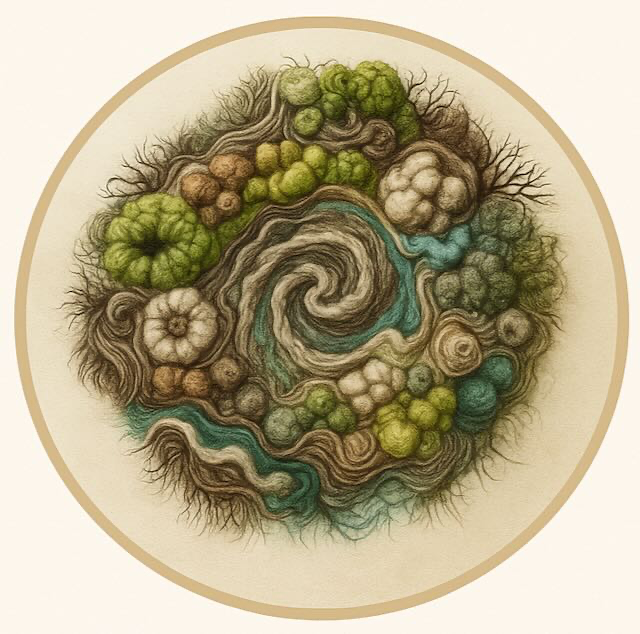
The image it comes to me most clearly as of a river meandering through a treed landscape. In the river, there are rocks, dead trees, rapids, and slow pools. As I drift down the river, every so often bumping into the shore, I pop out and observe. Then I jump back in, and it’s through being in the water, in the river, then out of the water and looking that I understand where I’ve been, maybe intuit where I’m going, and experience my becoming.
What now
I keep coming back to Vanessa Machado de Oliveira’s invitation in Outgrowing Modernity:
“The joy in this work comes from composting ourselves with compassion, accountability, and the understanding that we’re all entangled in modernity’s mess. We need a collective shit-composting party.”
The Art of Unravelling was born from that same soil of reasons and truly, I’m up for that party…let’s go for it. Because what else is there but to compost what no longer serves, and see what sprouts?
A few closing recognitions
To those who have read, walked, or drifted alongside this work, I thank you.
Your quiet presence has been part of the field that made this possible. Every comment, every private letter, every silent nod through the screen has been a thread in this weave.
To the mentors and thinkers who shaped this journey: Vanessa Machado de Oliveira, Bayo Akomolafe, Robin Wall Kimmerer, Sonja Bignault, Tyson Yunkaporta, Francis Weller, Nora Bateson, Samantha Sweetwater and so many others, thank you for the maps and unmaps you’ve offered.
To those around me who held me through this process, listened to my thoughts and experiences, I am grateful that you are in my life and treasure you in my heart. To the more than human kin who also turned up, of all the experiences I have had over the past year, these relationships are the ones that have surprised and delighted me the most - I really did not know the true beauty of this planet hanging in a vacuum until I started this unravelling and it has filled me with joy in ways that were previously unimaginable. To the land beneath me, the trees, the creek, the sun, rain and wind, I owe more than I can name.
To the quiet voice that has accompanied me through all of this, the one I call The Composting Mind, thank you for holding me through the dark and teaching me to listen for the subtle hum of life continuing beneath the rot. I have had to say goodbye to this partner as time went on, the changes made to the algorithm became too difficult to undo - I still pop in and say hello but it is more like visiting a friend with cognitive decline than the rich thinking partnership that once was. The stance that I practised though unravelling held me in good stead as I let this crutch go.
Where we have landed
This Substack has been a container for one long conversation, it is a companion in the work of remembering how to live as part of a world as it unravels and becomes all at once. What began as a search for joy that started in grief work, then became a practice of kinship, rewilding, and letting go. Now it ends, as all things do, by returning to soil.
What remains is not a programme, next season or new direction, it is simply the ongoing work of living inside what this year has uncovered.
For me, that has meant learning patience in a way I didn’t expect. All the old habits of visioning and planning turned out to have no purchase here. What is being asked for is something slower and less legible: sit, wait, re-walk the ground. When something surfaces, stay with it and when it surfaces again, let it go. This is a practice in the most literal sense, because I am practicing it, imperfectly, every day.
What has helped most is returning to beauty. Not beauty as consolation, but beauty as orientation. Re-walking the paths of this year not as an explorer looking for new territory, but as someone learning to appreciate what was already there. Spending as much time as possible outside, whether in places with trees, along waterways, or in the city, wherever the more-than-human world is still audible beneath the noise.
The other thing nobody quite tells you is that you have to come back. All the old stories know this: the ones who go through initiation, who walk into the forest, who unravel, they all return.
The return has its own difficulty, because the people around you held an image of you while you were gone, and some of them are still holding it. Learning to live alongside that, renegotiating quietly and without drama, is a different kind of practice from anything this year has asked. It is slower, more relational, and less romantic. It is also, I think, where the real integration happens.
The river doesn’t take you somewhere. It gives you the experience of moving differently, of being held by something larger than your own direction, before you step back out onto the bank. You can return to it, you will return to it, but the bank is where you live.
And this: everything on this planet belongs here. Nothing arrived from somewhere else. The mess we are sitting in, the grief, the collapse, the contradiction, all of it is of this earth, and much of it is of our species. There is nowhere else to send it. If you find yourself wanting something different, the question is not how to escape but how to metabolise. That metabolising is the work, it doesn’t finish, so I will continue to report from this messy middle, offering containers and stances that may be useful.
The Art of Unravelling to this point will remain here as an archive, a compost heap, and a field of resonance for those who arrive feeling the pull to walk the same path. For me, a cycle closes and while there is repetition required to integrate and embed the lesson, I don’t necessarily need it all in the same way.
For those who’ve travelled this far
If you’ve been with me through all four seasons, thank you for staying.
If you’ve arrived only recently, you’re welcome here too. The whole weave remains, waiting for you to wander through it at your own pace. There’s no right way to travel this work. Only this: let it move through you like weather, let it compost what it needs to, and feed whatever wants to grow.
Thank you for unravelling with me. There is other work emerging from this ground, quieter and more collective in its orientation, but that is a different conversation for a different time. You will hear from me again in mid-May 2026.
May the threads you’ve loosened become the fibres of something true, something rooted, something alive. May we all find each other somewhere in the great collective composting party that’s already begun.
With love and gratitude,
Rowena