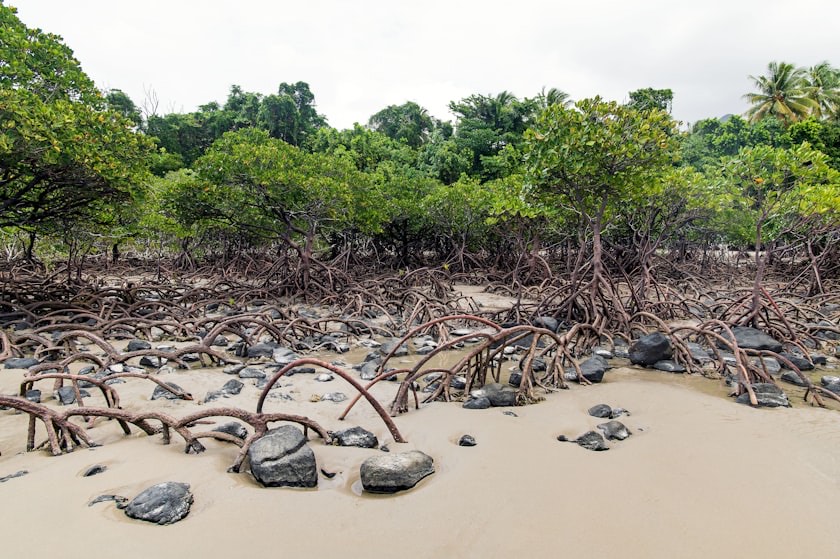
There’s a moment, standing at the shoreline, when the sand shifts beneath your feet. The tide moves, the water pulls, and for a second, you don’t know if you’re sinking or settling. This is the feeling of standing at an edge: of being between stability and movement, known and unknown.
Edges are where two systems meet. In nature, ecotones or the spaces between forests and grasslands, rivers and oceans, are the most biodiverse places on earth. In organisations, edges are where new ideas and unexpected futures emerge. In our personal worlds, edges are where we step into the unfamiliar, where we start to see differently.
What it means to walk the edge
In a world overflowing with information, we are trained to scan for certainty whether to sort, categorise, or know but true sensing work requires a different posture. It asks us to let go of immediate conclusions, to hold complexity without reducing it, to notice patterns before they become trends.
Walking the edge means practicing passionate non-attachment: caring deeply about what we see but not clinging so tightly that we close ourselves off to other ways of knowing. It means approaching information like an ecologist, rather than an engineer, not just fixing problems but observing what’s growing, shifting, and decaying in the system.
From data to pattern to meaning
In the business world, environmental scanning has long been a strategic tool. But much of it is about confirming what’s already expected: tracking metrics, watching competitors, reading industry reports. True edge-walking requires expanding beyond conventional inputs.
What happens if we look outside our fields? If we notice what’s being said (and not said) in art, activism, ecosystems, Indigenous knowledge, grassroots movements? What if we scan for the tensions, for the things that don’t fit neatly into current models?
Environmental scanning practice is one of learning how to see at the edges of your worldviews. Identifying here the boundaries of your thinking lie, and then moving slightly beyond them to ‘see’ what may be emerging.
How can I do this?
Edge-walking is not about predicting the future, it’s about sensing it before it fully arrives. It asks us to let go of immediate conclusions, to hold complexity without reducing it, and to notice patterns before they become trends. It is the practice of learning how to see at the boundaries of your own worldview, and then moving slightly beyond them.
This work of sensing the edge requires two distinct capacities: the ability to orient ourselves internally amidst the drift, and the ability to perceive the external landscape with new eyes. One is the work of the compass; the other is the work of the scout. To support this, I have created two complementary practices.
The inner tool: Your Drift Compass
Before we can meaningfully scan the horizon, we must first find our own footing. When you feel adrift in complexity or uncertainty, the first act of edge-walking is to turn inward, to find what holds you.
The Drift Compass is a soft tool for this work of inner orientation. It is a practice for finding your bearings when you don’t know what comes next. It holds four postures that act as directional forces for your attention: Listen, Tend, Offer, and Anchor.
This practice is a gentle, structured inquiry for when you need to ground yourself in what is true and steady within. It is not about finding answers, but about reconnecting with the capacity to respond from a place of quiet clarity.
The full Practice Card guides you through a 30-minute reflective process, with specific questions for each of the four directions to help you listen to what is stirring within.
The outer tool: An AI buddy for the edge
Once you have a sense of your own orientation, you may be called to look further afield, to explore the edges of a question or a system. A surprising ally in this process is an AI conversation partner: not as an oracle of truth, but as a scout that can help you see beyond the edges of your own map.
‘Edge walking with an AI buddy’ is a practice for expanding your field of vision. It uses an AI partner as a ‘provocation machine’ to surface your blind spots, challenge your default ways of thinking, and reveal unexpected connections. It is a way to ask:
What perspectives am I missing?
What competing narratives are at play here?
What are the assumptions that underpin my understanding?
This cognitive exploration is held within an embodied frame, ensuring you stay grounded as you venture into complexity.
The full Practice Card provides a detailed 1-2 hour framework for this deep dive, including specific prompts and a structure to hold you as you explore the edge of your understanding.
Two practice cards for walking the edge
For those called to this work, I have created two dedicated Practice Cards. They can be used separately whenever you need them, or together as a way of moving between inner orientation and outer exploration.
The Drift Compass: A 30-minute internal practice for finding your bearings in the drift. A tool for grounding and listening.
Edge walking with an AI buddy: A 1-2 hour external practice for expanding your perception and sensing emerging patterns. A tool for scouting the horizon.
The Art of Unravelling is offered as a gift, sustained by those who feel called to support the weaving. If you’d like to help tend the fabric of this work, you can contribute via the link below.