
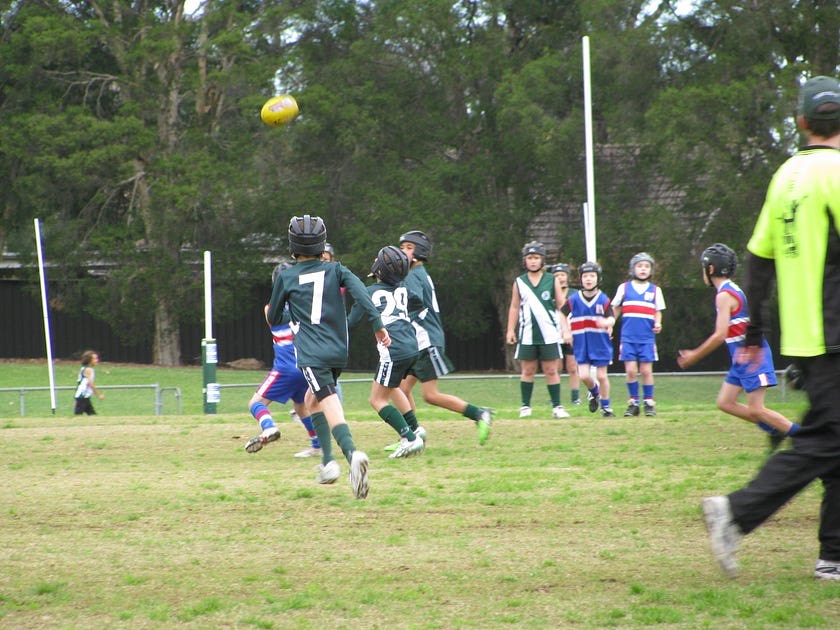
I spent years on the side of an AFL ground, years taking my turn doing the work to support the team and talking to the other parents.
AFL is Australian rules football, played in winter for 4 quarters, so the games can go for up to a couple of hours. Juniors are played on a Sunday from 8am - the younger the player, the earlier the game.
Memorising the boys’ and girls jumper numbers so I could call out the right name, whether to encourage or commiserate. Remembering parents’ names, siblings, grandparents and what could be discussed, and what should be gently left alone.
In the early years, I sometimes had to hold in my boredom or disinterest, not always successfully. But as the boys grew more skilful, the game drew me in. I was riveted by the drama on field: those times they rose above what they thought was possible or completely tanked the game because their hearts weren’t in it.
There was never a clear arc but there was always care.
Years of picking up smelly, sweaty boys after training in the dark. Listening to them talk in the backseat, in their own language, letting the conversation happen between them.
Years spent with people who are still some of my closest friends not because we set out to become close, but because we shared time, we weathered the seasons together, quietly.
Off the back of reading Helen Garner’s wonderful book - The Season, I’ve been thinking about this experience at the suburban footy club. Not because it’s visionary or radical but because it stays. There’s no grand transformation, no “aha” moment. Just a rhythm of people turning up, doing their bit, forgetting things, forgiving each other, and showing up again next week.
The parents volunteer each week in the cold and the dark, and they do it for all sorts of reasons. For themselves, for the glory, to win. For their kid who loves the game, for the kid who hates the game but loves the team. For the one who really tries, and the one who flies.
The jobs that need doing are always there, up for grabs and never glamorous:
Oranges.
Canteen.
First aid.
Trainer.
Coach.
Manager.
All the assistants.
The warm jacket offered to a kid on the bench. The extra water bottle someone remembered to bring. The clumsy folding of a marquee in the wind. And then there’s the work that happens behind and between the scenes…the quiet relational field.
Remembering it’s someone’s 50th game.
Noticing who’s had a haircut (or hasn’t).
Asking how school’s going.
Checking in when someone’s been quieter than usual.
No one’s writing this down. It’s just held. By people who don’t all like each other, but who care enough to keep turning up.
This is kinship, too.
Not in the shape of shared vision or deep transformation but in the form of co-presence, continuity, and care.
No one’s in charge of the whole.
And no one can make anyone do anything they don’t want to.
But somehow, it happens.
Not because of structure.
Not because of certainty.
But because enough people are tuned to the same rhythm, even if they’d never name it that way.
Maybe drifting together isn’t about building something new.
Maybe it’s about tending what’s already here gently, loosely, with just enough care to keep going.
In a season of drifting, this might be the most radical thing of all:
To keep showing up without needing clarity.
To do the jobs that need doing and hold the stories that aren’t being told.
To stay together in motion, not perfectly, but enough.
About The Season – Helen Garner
Helen Garner’s The Season is not really a book about football.
It’s a book about showing up, about what it means to be part of something that doesn’t ask for transformation, just presence.
At 80 years old, Garner follows her grandson Amby’s under-16s footy team through a full year in Melbourne’s western suburbs. She stands on sidelines in the cold. She watches the drills, the rituals, the injuries, the joy. She’s there because she wants to understand him better, this boy becoming a man, and because she senses that something precious lives in the ordinary repetitions of the season.
What she captures is not just the game, but the ecosystem of care that grows around it: the quiet commitment of parents and volunteers, the resilience and roughness of the boys, the culture of belonging that forms between people who might not say much but who keep turning up anyway.
Garner doesn’t romanticise it. She notices the awkward moments, the silences, the gaps in understanding. She also writes about aging, mortality, and the fierce desire to stay close to those we love, even when the worlds we move through no longer feel like our own. Her prose is sharp, observational, and deeply generous. And what she offers, gently but clearly, is a reminder:
Sometimes kinship is not built through revelation or rupture. It’s built through return. Through repetition. Through showing up, again and again, without needing it to become more than it is.
This is not a book about victory, it’s a book about coherence and that’s why it belongs here, where we’re learning how to stay with each other in the middle of the drift.
The Art of Unravelling is offered as a gift, sustained by those who feel called to support the weaving. If you’d like to help tend the fabric of this work, you can contribute via the link below.