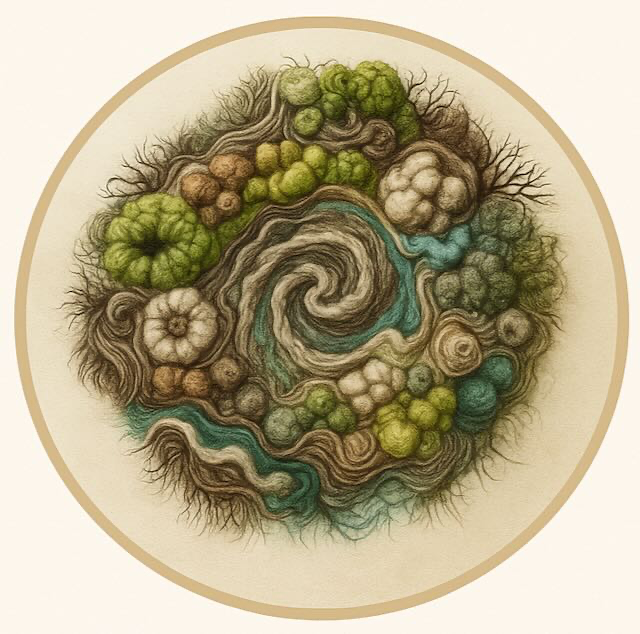

By now we’ve named our tone, practiced returning after disruption, and noticed what we broadcast into the field. Resonance isn’t always steady hum, it can falter, bend and sometimes it cracks. There are days when no matter what you do, the note won’t sit true. You feel it in your gut or hear it in your voice: something is off. This isn’t failure. It’s part of the music, every life carries moments of dissonance.
Sometimes an off-note is just a passing wobble. A breath, a pause, and you’re back, but other times it’s more like snow packed hard across a road. You can’t sweep it aside, you have to chip at it, melt it, give it real attention. This is how inherited patterns work: intergenerational trauma, learned fears, habits etched deep. They surface as stuckness, anxiety, overreaction. The work isn’t to bulldoze through but to notice, tend, and slowly clear.
How do you know something is off?
The first job is noticing. An off-note usually shows up as a felt sense before it becomes a story. Here are common somatic and cognitive signs:
Somatic signs
Tightness in the chest, jaw, throat or belly
Shallow or irregular breath, a sense of being breathless or overstimulated
Fatigue that feels like heaviness rather than physical tiredness
Nervous energy: shakiness, restlessness, nausea, headaches
Cognitive / relational signs
Repetitive anxious stories in the head (“I should…” / “What will they think?”)
Sudden reactivity: snapping, freezing, shutting down
Rehearsing conversations, dread before social contact
Everything feels amplified (overly sensitive) or flattened (numb, indrawn)
If you notice these, there is an off-note. The next question: whose note?
Collective Dissonance
Not every off-note belongs to you, some belong to the field. You feel the weight of a culture that is fractured, of systems designed out of tune with life. It’s easy to internalise this as personal failure, when in truth you’re carrying a resonance that isn’t yours alone.
Repair here means recognising what is shared. Sitting with the heaviness together. Naming that some dissonance is structural, not individual and that waiting, grieving, or witnessing is also part of the music.
Housekeeping for the Soul
When resonance falters, what’s needed is not shame but housekeeping. Not perfection, but repair. The work is ordinary, and often unglamorous:
Clearing: writing it out, moving the body, releasing static.
Thawing: warmth and compassion, letting grief or fear soften in their own time.
Composting: taking the residue of old patterns and letting them feed something new.
Pausing: sometimes the truest action is waiting, resting until the note can sound again.
Each of these are a way of saying: I will not abandon myself when I fall out of tune. I will tend the instrument and let it return in its own rhythm.
The Resonance Repair Kit: Internal Repair
Here’s the truth: knowing the pathways is not the same as walking them.
You can read about clearing, thawing, composting, and pausing. You can nod along and think, “Yes, that makes sense.” But to actually do the work, to sit with what is frozen, to release what no longer serves, to trust the slow return, that asks for something different. It asks for time. For scaffolding. For a container strong enough to hold what might surface.
The Resonance Repair Kit is a contained practice designed to guide you through the work of returning to resonance. We’ll work with it over two weeks: this week focusing on internal repair (when you are the one out of tune), and next week turning to field repair (when the dissonance belongs to the room, the system, or the collective field).
This week’s focus is internal repair. Inside the Kit, you’ll find:
Concrete, low-bar rituals to start thawing and clearing (somatic resets you can do in 5–15 minutes)
Medium work for hours or days (journaling prompts, gentle bodywork, noticing repeating stories)
Deeper tending for weeks or months (therapeutic support, grief practices, safe containers for feelings)
Gentle boundaries to hold while healing (protecting sleep, reducing decision load)
Signs you’re returning to resonance (so you know repair has begun)
This is not something to skim. It’s not a worksheet or a checklist. It’s a practice chamber: a place you step into deliberately, with time set aside and your full attention present.
It will ask you to sit with what is tender. To name what is frozen. To release what you’ve been holding out of fear or habit. And to trust that even what feels broken can feed the song.
If you feel the pull to stop reading and enter the work itself, you’re invited to step into the Resonance Repair Kit.
This practice is designed to be done slowly, in one or more sittings. There is no outcome required. Waiting is part of the work.
Next week, we’ll turn to the other source of dissonance: when it’s not your instrument that’s off, but the room you’re playing in.
How to tell you’re making progress
Signs you’re returning to resonance:
Tiny reductions in baseline tension (jaw less clenched, breath softer).
More ability to notice the moment of reactivity and choose differently.
Conversations leave you restored or neutral instead of hollow.
You can tolerate structural dissonance without immediate collapse (not the same as resignation).
Reflection invitation
This week, notice:
Where am I hearing off-notes in myself?
Which ones belong to me, and which ones belong to the field?
What’s my instinct, is it to hide the dissonance, to push harder, or to pause and repair?
Which housekeeping ritual clears the static most gently?
Let’s choose a compassionate posture
Remember: distinguishing instrument vs acoustics is not a moral test. It’s a practical one. The world is noisy and often deliberately de-tuned. Learning the difference helps you stop individualising what belongs to systems and gives you a path for repair that is honest, sustainable, and collective when it needs to be.
The Art of Unravelling is offered as a gift, sustained by those who feel called to support the weaving. If you’d like to help tend the fabric of this work, you can contribute via the link below.